

Fear of vulnerability in relationships is a profound internal barrier rooted deeply in psychological and somatic layers of the self. It manifests as emotional withdrawal, guardedness, or compulsive control that blocks authentic intimacy. This fear often entangles with the body’s unconscious defenses—what Wilhelm Reich named body armor or character armor—embedding emotional suppression and rigidity within the muscular and energy systems. High-achieving individuals, such as the Perfectionist or Achiever character structure, frequently exhibit this fear as an adaptive survival strategy developed in early relational trauma or complex family dynamics, including the unresolved oedipal wound. Understanding the bioenergetic and Reichian underpinnings of fear of vulnerability enriches our capacity to engage in meaningful, sustainable change both as psychotherapists and as people navigating relationships.
The consequential fears revolve around exposure, emotional helplessness, and perceived loss of control—all experienced somatically as tightening of the diaphragm, clenched jaws, or immobilization of the pelvic area in the adult’s body. Exploring this psychosomatic configuration is vital for illuminating the intricate interplay between fear, body tension, and relational patterns.
Below, the exploration unfolds in a layered structure to provide a comprehensive understanding blending theory and praxis.
Foundations of Fear: The Somatic and Psychological Roots
To decode the fear of vulnerability in relationships, one must first grasp the somatic scaffolding built during early development and early relational patterns. This foundation is not just metaphorical but literally etched into the body’s muscular and energetic system as character armor. Wilhelm Reich’s pioneering insights situate emotional defenses as chronic bodily tensions—that lock parts of the self away from conscious experience and connection.
Body Armor and Character Structures: The Five Basic Types
Reich’s work identifies five primary character structures that map not only psychological traits but somatic patterns of tension: the Schizoid, Oral, Psychopathic, Masochistic (or Narcissistic), and the Genital character. The fear of vulnerability often manifests most acutely in the Oral and Narcissistic characters, where early trust ruptures or abandonment reinforce self-protection through withdrawal or overcompensation.
The Achiever and Perfectionist typify the Exzessen-Masochistic character in Reichian terms, employing somatic rigidity—often seen as chronic muscle tightening especially in the shoulders, neck, and jaw—to maintain the illusion of control and emotional invulnerability. In bioenergetics, Alexander Lowen elaborates on this as suppression of the root chakra energy, a stoic contraction of the pelvic floor and abdomen represents an unconscious effort to protect the self from relational injury.
Oedipal Wound and Developmental Roots of Vulnerability Fear
The oedipal wound is a psychoanalytic concept capturing early unconscious conflicts within the primary family system that drastically shape adult relational capacities. This "wound" often triggers a core fear of vulnerability, as early experiences condition the self to anticipate emotional rejection when needs for closeness are expressed.
Emotional suppression as a response creates a schism between felt reality and outward expression, quaternioned in the body through disrupted breathing, shallow chest expansion, and inhibited pelvic mobility. These somatic constrictions correspond with emotional blocks, fostering an internal landscape hostile to yielding, softness, and thereby intimacy.
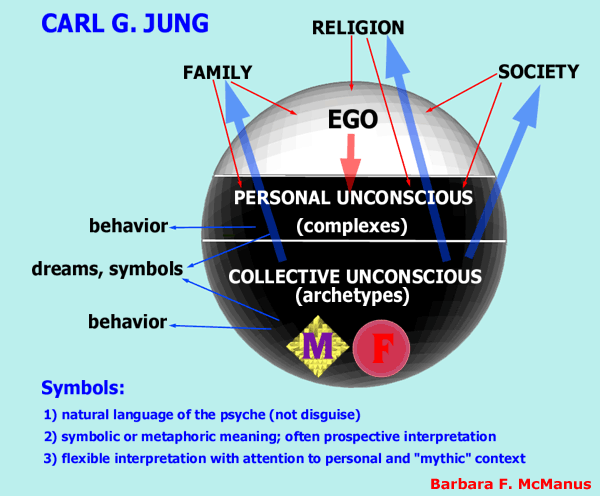
Emotional Suppression and the Gatekeeping Role of the Body
From a somatic therapy perspective, the crucial understanding is that the body does not merely reflect these fears but actively maintains them through chronic tension patterns. The fear of vulnerability is locked in these somatic habits, sustaining a protective shell which shapes not only personal identity but relational interaction.
This explains why cognitive interventions alone tend to fall short: the emotions lodged in muscular defenses remain unaddressed, perpetuating a cycle of guardedness and relational stasis. Lowen’s bioenergetic exercises, such as grounding and breathing techniques, aim to soften this armor, engaging energy flow within the body and releasing suppressed emotional material as a pathway toward safer vulnerability.
Psychodynamics of Vulnerability Fear in High-Achieving and Emotionally Guarded Individuals
Transitioning from the foundational somatic layers, it is essential to explore the psychodynamics specific to high-achieving or emotionally guarded adults who embody the Achiever and Perfectionist characters. Their inner narrative often involves intense self-regulation, relentless standards, and a pervasive fear that surrendering emotion equals weakness.
The Protective Function of Perfectionism
Perfectionism frequently operates as a strategic defense to mitigate the fear of vulnerability in relationships. It ensures predictability and minimizes emotional risk by presenting a flawless self to the other. This hyper-control extends into the body with acute muscular rigidity and habitual tension.
In therapeutic terms, the challenge lies in revealing how perfectionism masks a deeper fragility—unveiling this paradox requires cultivating a therapeutic alliance that tolerates emotional exposure without judgment. Bioenergetic grounding fosters this by reconnecting the client to a felt sense of safety within their own body before extending it relationally.
The Obsessional Character and Its Rigidity in Relation to Vulnerability
The Obsessional character is characterized by excessive orderliness, control, and a strict internalized moral code. This rigidity echoes through the body as constrained breathing, stiff posture, and restricted pelvic area—which becomes a fortress guarding against vulnerability.
From a Reichian perspective, the obsessional holds a deep unconscious fear of disintegration and chaos; therefore, vulnerability threatens the integrity of their constructed emotional fortress. Softening this armor requires not just cognitive insight but somatic release, affirming that allowing energy to flow increases resilience rather than diminishes it.
Emotional Guardedness and the Achiever
The Achiever channels energy into performance, results, and external validation, subtly conflating achievement with personal worth. Vulnerability signals an internal void or failure to this self-concept, evoking profound anxiety.
Somatic symptoms correspond: diaphragm tightness that limits deep breathing and cardiac expansion, muscular contractions in the upper chest, and habitual downward gaze keeping vulnerable eyes shielded. Through focused somatic work, these habitual patterns loosen, and the individual gains access to authentic feelings underlying achievement—thus integrating vulnerability as a strength in relational dynamics.
Body-Centered Healing Approaches to Overcoming Fear of Vulnerability in Relationships
The shift from understanding to healing requires integrating somatic therapy principles with psychoanalytic and psychodynamic insights. Body psychotherapy offers an indispensable modality to work directly with the entrenched body armor that sustains emotional suppression and relational distance.
Bioenergetic Analysis: Mobilizing Energy to Soften Character Armor
Alexander Lowen’s bioenergetics emphasizes the inseparability of body and mind, proposing that repressed emotions manifest as energy blockages and muscular tensions. Bioenergetic exercises facilitate the release of these blocks, supporting a gentler, more fluid somatic state that accompanies increased emotional openness.
Examples include grounding techniques to reconnect with bodily sensations, breathing exercises to expand the diaphragm and restore natural breath patterns, and expressive movements designed to unlock pelvic and spinal rigidity. These practices cultivate the capacity to engage vulnerability safely rather than avoid it.
Somatic Experiencing and Tracking Internal Sensations
Somatic Experiencing respects the wisdom of the nervous system, helping clients track felt senses that arise with vulnerability. This moment-to-moment awareness helps recalibrate the body’s response from defensive contraction to receptive openness.
The therapist guides the individual to notice subtle changes in bodily sensation during relational interaction—such as heart rate, muscle tension, or breathing shifts—which acts as a real-time feedback loop cultivating relational trust and emotional attunement.
Character Structure Integration and Emotional Release
Reichian character analysis and therapy focus on identifying and working with specific layers of body armor corresponding to distinct character types. Emotional release techniques, such as therapeutic catharsis and expressive vocalization, enable the discharge of pent-up emotions locked in muscular tension.
This holistic process gradually dismantles the unconscious defenses sustaining the fear of vulnerability, allowing for a more genuine connection between self and others. These approaches emphasize safety and pacing, recognizing that dismantling armor built over decades cannot be rushed.
Practical Implications for Psychotherapists and Psychology Students Working with Vulnerability Fear
For clinicians encountering clients with fear of vulnerability in relationships, understanding the somatic dimension is crucial. Integrating Reichian and Lowenian theories enriches assessment and intervention strategies, enhancing therapeutic efficacy.
Assessing Character Structure Through Body Language and Muscle Tone
Therapists trained in bioenergetic analysis assess posture, muscle tone, breathing patterns, and expressive gestures to deduce underlying character armor. Recognition of a client’s dominant character structure informs tailored interventions—whether strengthening grounding for the Oral character or encouraging emotional release in Obsessional types.
Creating a Therapeutic Container for Safe Vulnerability
A high-achieving, emotionally guarded client may initially resist vulnerability fearing exposure. Therapists must cultivate a space where emotional expression and bodily release feel contained and supported. rigid structure , empathic attunement, and somatic tracking create conditions that can gradually disarm defenses.
Bridging Insight with Somatic Practice
Psychology students and clinicians alike benefit from experiential learning in body-centered modalities. Theory without somatic embodiment often limits the understanding of vulnerability fear, whereas integrating bioenergetic exercises into therapy facilitates deeper relational breakthroughs.
Summary and Actionable Steps to Overcome Fear of Vulnerability in Relationships
Fear of vulnerability in relationships is fundamentally an embodied phenomenon where body armor and emotional suppression intersect. Recognizing how character structures like the Achiever, Perfectionist, and Obsessional manifest this fear is vital. Healing unfolds through somatic engagement, bioenergetic release, and psychoanalytic insight, collectively softening chronic muscular tension and unlocking authentic emotional expression.
Actionable steps for psychotherapists, students, and individuals seeking self-understanding include:
- Developing somatic awareness through grounded breathing and body scanning to detect where tension converges.
- Exploring family dynamics and early relational injuries, emphasizing the oedipal wound's role in shaping vulnerability avoidance.
- Incorporating bioenergetic exercises that expand diaphragmatic breathing, pelvic mobility, and expressive movement to reduce rigidity.
- Practicing somatic tracking of feelings in relational interactions, gradually increasing tolerance for emotional openness.
- Creating or seeking therapeutic spaces that honor pacing and safety in dismantling defenses.
Building relational courage demands integration of mind and body, inviting a new relational paradigm where vulnerability is neither feared nor avoided but embraced as a vital path to connection and resilience.